Prerequisites / recommended skill level
| Prerequisite | Importance | Notes |
|---|---|---|
| Research Data Management | Helpful | RDM lifecycle |
Summary
Research outcomes encompass publications, data, software, bibliographical material and any other resources (such as experimental workflows, standards) that can be potentially useful for conducting research.
A Research Object (RO) Garcia-Silva et al., 2019 is a method for the identification, aggregation and exchange of scholarly information on the Web. ROs allow working ‘open by design’ and share research outputs during the research process and not only results at the end. The primary goal of the RO approach is to provide a mechanism to associate or link related resources about a research investigation so that they can be shared using a single identifier [def] Belhajjame et al., 2015.
In this chapter, we will introduce ROs, their typologies and which platform and technologies exist to create and publish them.
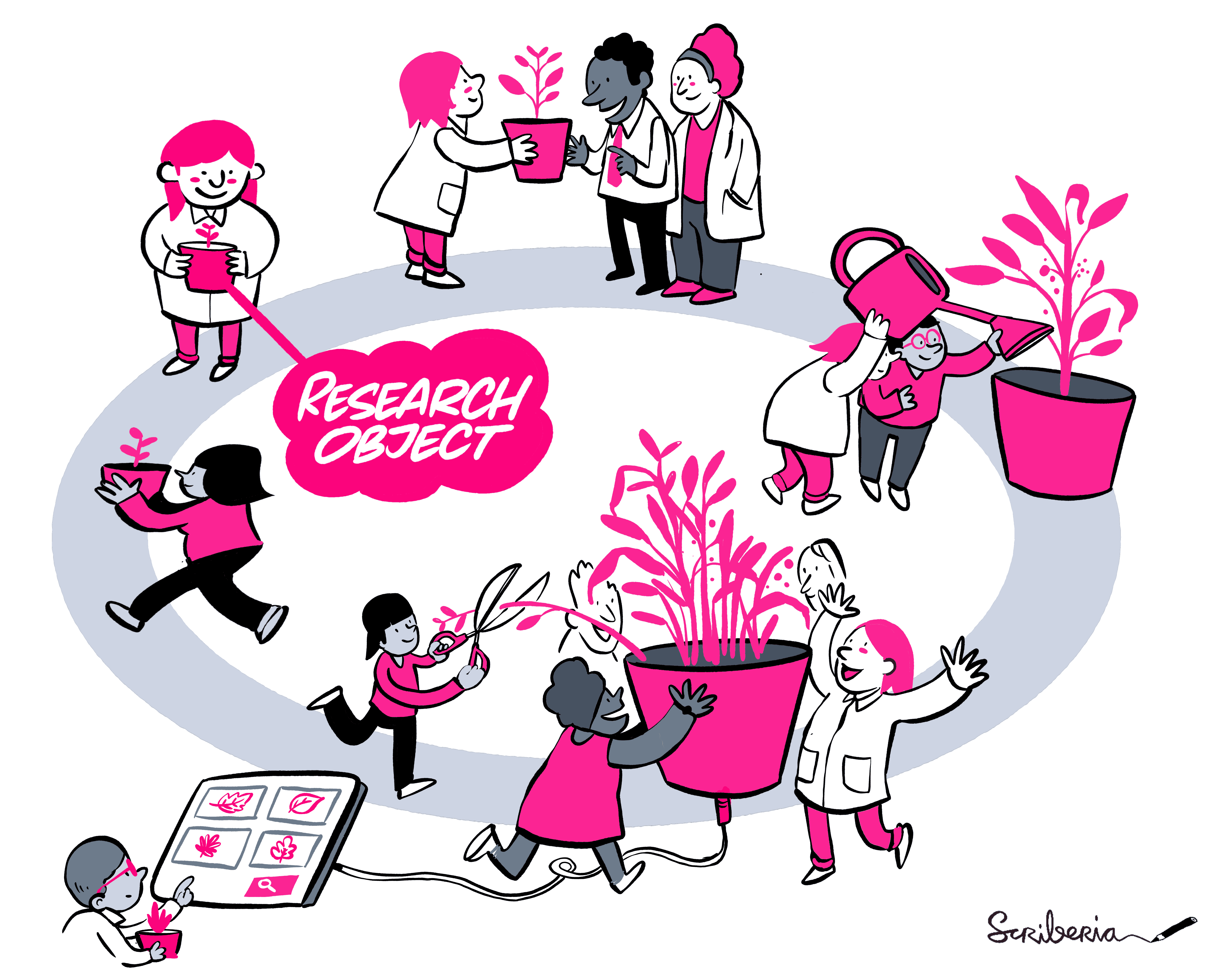
Figure 1:Research Objects allow working open by design and share during the research process and not only the research outputs at the end. The Turing Way project illustration by Scriberia. Used under a CC-BY 4.0 licence. DOI: The Turing Way Community & Scriberia (2024).
Background & Motivation
ROs are living resources helping to organise and describe the inputs, materials, and methods used in a scientific experiment and obtained as a result and not only at the end when publishing the research outcomes. ROs encompass research outputs created, revised and shared throughout the research lifecycle that help validate findings claimed in scholarly publications. In short, ROs can be seen as a “single information unit” where any research material can be shared with other scientists at discrete milestones of the investigation within and outside the project.
Motivation behind RO is the need to identify and share all components such as data, source code, tools, method documentation, as well as communication materials such as presentations, videos, blogs and other tangible outcomes. The entire research lifecycle can be captured, allowing the release and publication of results progressively, keeping track of versioning and change information. ROs facilitate reproducibility of the scientific methods and results through access to resources, context and metadata, and reuse with the possibility of forking existing ROs.
There are three guiding principles for RO:
Digital identity - Using unique identifiers, such as DOIs for tangible outcomes such as publications or data, and ORCID iDs for researchers (explained in detail in the ORCID section). These persistent identifiers are part of an interconnected open scholarly infrastructure - see our chapter on persistent identifiers.
Data aggregation - Using a method to aggregate all outcomes so that they are discoverable and hence allow anyone to investigate and reproduce the research.
Annotation - Use rich machine-readable metadata (discussed in Chapter on Documentation and Metadata) that help ensure findability and accessibility of all scientific work. RO helps understand the entire research lifecycle through research outcomes including publication shared progressively, allowing to track the versioning and development of the entire project.
All the research work, including potential failures, dead ends or any other information such as experimental protocols, software code, standards as well as all the individuals who contributed to the research can also be recorded in the RO. As a result, ROs support evidence and support validation of findings claimed in scholarly articles.
Interim Research Outputs
Research objects span the entire research lifecycle, not just final peer-reviewed publications. Interim research outputs - including preprints, protocols, data management plans, and preliminary datasets - can all be published with persistent identifiers and formally cited, enabling transparency and incremental credit for research work.
Each type of interim output serves a distinct purpose in the research process. Preprints enable rapid sharing of findings before peer review, protocols document methodologies for reproducibility, Data Management Plans demonstrate rigorous planning, and preliminary data allow validation and feedback from the community. Publishing these outputs with DOIs creates a traceable record of your research evolution and allows others to build on your work at every stage. Making interim outputs citable benefits both individual researchers and the broader community. Researchers receive credit for methodological innovations and early-stage work, while the community gains access to protocols, receives earlier feedback opportunities, and can identify complementary research efforts sooner. The infrastructure for making these outputs citable is straightforward - most platforms automatically assign DOIs when you publish.
For specific guidance on publishing different types of interim research outputs:
Preprints: See our guidance on preprint DOI workflows
Protocols: Learn about protocols as citable objects
Data Management Plans: Discover DMPs as research objects
Understanding DOIs: Read our chapter on persistent identifiers for infrastructure details
Linking outputs: See connecting research through metadata for creating relationships between interim and final outputs
Contribute to this Chapter
We invite all contributions in the following areas:
Add or update relevant concepts regarding ROs and related concept such as FAIR Digital Objects De Smedt et al., 2020;
Complete and/or add information about typologies;
Include additional implementation of ROs and associated services.
- Garcia-Silva, A., Gomez-Perez, J. M., Palma, R., Krystek, M., Mantovani, S., Foglini, F., Grande, V., De Leo, F., Salvi, S., Trasatti, E., Romaniello, V., Albani, M., Silvagni, C., Leone, R., Marelli, F., Albani, S., Lazzarini, M., Napier, H. J., Glaves, H. M., … Altintas, I. (2019). Enabling FAIR research in Earth Science through research objects. Future Generation Computer Systems, 98, 550–564. https://doi.org/10.1016/j.future.2019.03.046
- Belhajjame, K., Zhao, J., Garijo, D., Gamble, M., Hettne, K., Palma, R., Mina, E., Corcho, O., G\ifmmode\acuteo\elseó\fimez-P\ifmmode\acutee\elseé\firez, J. M., Bechhofer, S., & others. (2015). Using a suite of ontologies for preserving workflow-centric research objects. Journal of Web Semantics, 32, 16–42. 10.1016/j.websem.2015.01.003
- The Turing Way Community, & Scriberia. (2024). Illustrations from The Turing Way: Shared under CC-BY 4.0 for reuse. Zenodo. 10.5281/ZENODO.3332807
- De Smedt, K., Koureas, D., & Wittenburg, P. (2020). FAIR Digital Objects for Science: From Data Pieces to Actionable Knowledge Units. Publications, 8(2). 10.3390/publications8020021