Overview
Curriculum development is an ongoing process aimed at finding new and effective ways to provide students with intellectually challenging and personally inspiring learning experiences. Determining the appropriate level for students and defining learning outcomes are essential when designing a lesson or curriculum. This process varies based on the program of study, such as undergraduate, postgraduate, or flexible learning programs. Data science students, for example, learn complex concepts early in their programs, whereas students taking optional data science courses later in their degree do so at a different pace. By understanding the learners and program requirements and learning outcomes, educators can tailor the curriculum to match the year of study, ensuring course-specific outcomes and competencies are suitably challenging. Frameworks like Bloom’s Taxonomy can help educators structure courses to progress from fundamental to advanced skills, enhancing the students’ learning experience. This chapter will discuss techniques for defining learning outcomes, designing practical and theoretical teaching sessions, outlining learning principles, and examining the characteristics of adult learning and their implications for educators.
Defining Learning Outcomes (LOs)
When developing a lesson or curriculum, you need to determine the appropriate level of study, as similar courses can be taught in both undergraduate and postgraduate programs. The complexity of the material and the type of degree will vary and determine the learning outcomes. For example, students specialising in data science will encounter more complex concepts earlier in their studies compared to those students not specialising in data science and taking optional courses later in their programs.
Once the program and its requirements (program learning outcomes) are known, the year of study provides an indication of the level of study. With this context set, you can move on to specifics about the course, such as the course learning outcomes and the level of competency expected by the end of the course. These outcomes can be developed using Bloom’s Taxonomy, where earlier courses on a program focus more on remembering and understanding information, while later courses move towards evaluating, analysing and creating new methods and knowledge.
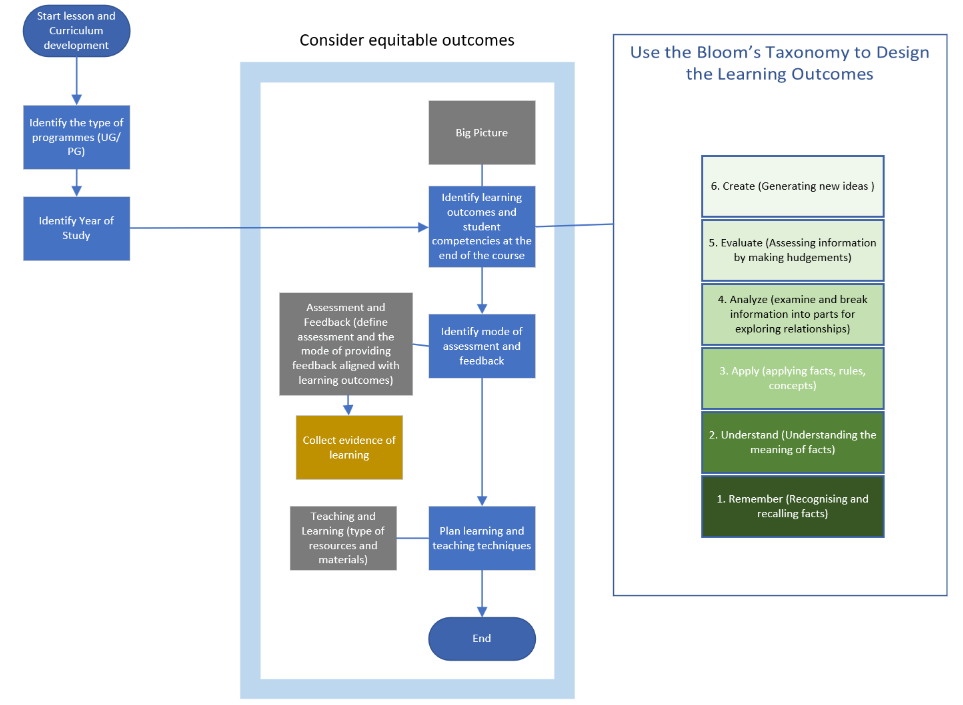
Figure 1:System for Developing Effective Learning Outcomes for Curriculum or Lessons. Image created by Gule Saman building on John Biggs and Benjamin Bloom’s work. Used under a CC-BY 4.0 license.
The learning outcomes can be developed using the helpful list of verbs given in Figure 2. The LOs provide a broad overview of the course. Next, identify how you will assess the students, considering the frequency and mode of assessment, alongside how you intend to provide feedback and the frequency of providing feedback. At this point, you can collect evidence of previous learning to improve course delivery for future iterations. Once the learning outcomes and assessments have been defined, draft a plan for the teaching and learning techniques to be used for the course. It is very crucial to ensure that the outcomes of the processes and course are equitable, equity should be considered from the start and not introduced as an afterthought.
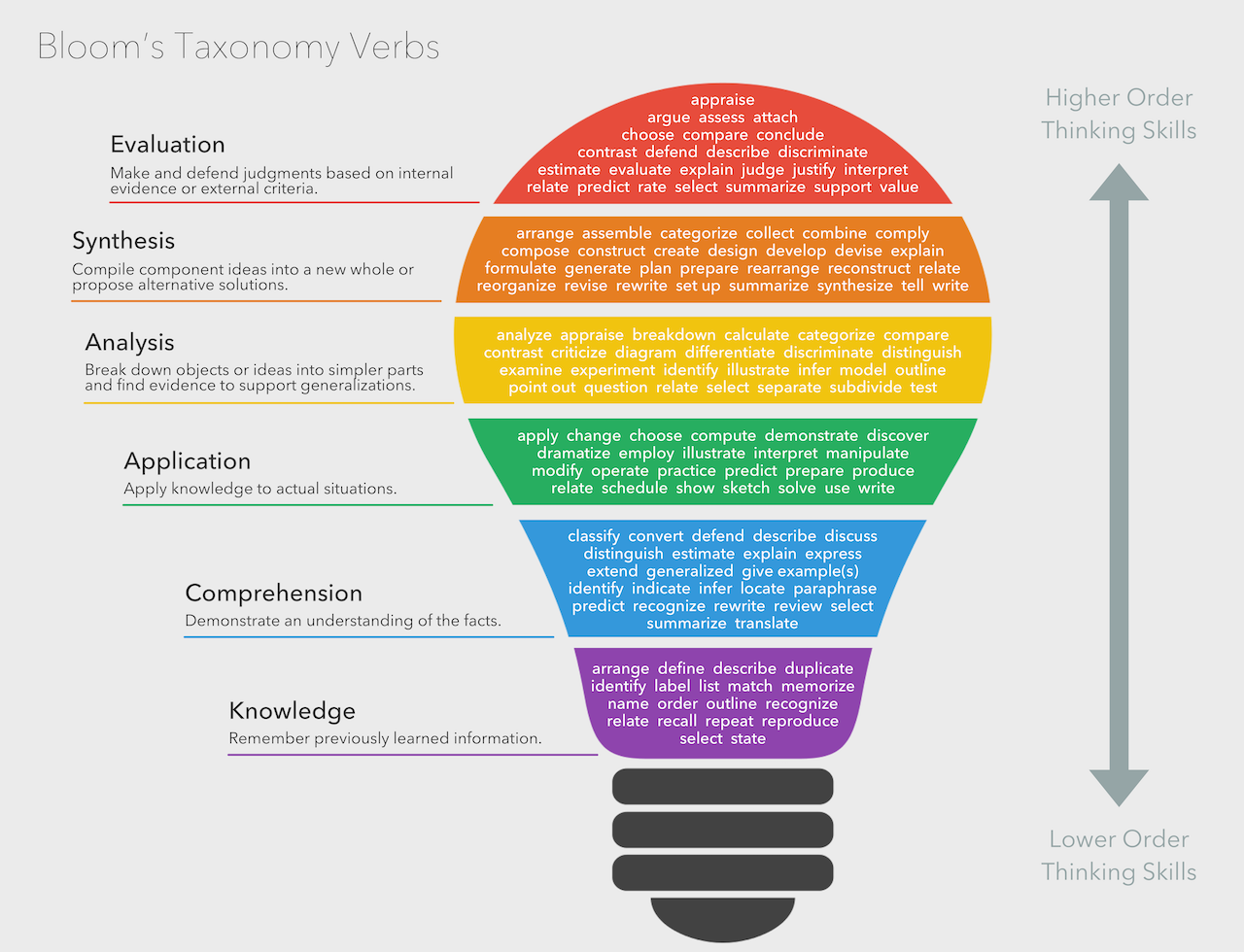
Figure 2:Bloom’s Taxonomy List of Verbs for creating Learning outcomes (Curriculum/Lesson). “Bloom’s Taxonomy Verbs” by Fractus Learning is used under a CC BY 4.0 License.
Types of Sessions
Any learning, especially Science learning, can be divided into two parts: theoretical and practical. It is essential to make both types of sessions engaging for the students to enhance learning, it can be done by incorporating a variety of interactive and dynamic teaching methods, such as multimedia integration, interactive techniques, coding demonstration, personalisation, group work and signposting the lecture contents.
Theoretical Sessions
Creating a good theoretical knowledge base for any topic is essential for effective learning and their implementation.
This process has the following key components:
Developing the theory: Establishing a theoretical foundation is important for data scientists to develop their skills to solve real world problems. Introduce fundamental concepts and theories related to the topic, ensuring that the learners grasp the essential principles before moving to more complex concepts. The explanation should be clear and concise, supported by relevant examples preferably real world to which the students can relate to. These concepts can be demonstrated through a dataset that is provided at the start of the course and examined when each component is being studied. These datasets can be opensource data or mock data that is generated specifically for this purpose.
Signposting Advanced Resources: Students can have different levels of learning and interests on a topic. Signposting them towards relevant resources, for example, academic papers, books, online resources or expert talks is useful. It is essential to point the students towards reputable resources or provide a curated list for the whole course while dividing it into themes/topics that align with the course contents.
Practical Sessions
To make learning more effective and interactive demonstrating the application of the theoretical concepts is useful, designing the practical sessions according to the demographics, capabilities and background of the students is essential. Practical sessions should be integrated into the curriculum and lesson design.
There are different teaching methods that can be used to deliver practical sessions, some of which are summarised in Table 1. For example, for shorter sessions (1-hour) you can use flipped learning to maximise the efficiency of the learning process. Choosing flipped learning would depend on the demographics and preference of a cohort. Depending on the feasibility and preferences various forms of study material can be provided, for example, pre-recorded short lecture, reading material, provision of skeleton code that will be discussed or modified during the session. The in-class time should be dedicated to discussion, problem-solving, Q&A and hands-on activities to make it more engaging.
Checklist for planning different types of session
Clearly define the competencies and learning outcomes
Specify the tools and libraries students are expected to learn to use
Learning outcomes of the course/session
Revisit outcomes to help students track their progress
Understand the practical application of the learning
Identify the learning styles to be used: 1. Visual, 2. Auditory and 3. Kin-aesthetic (see Table 2)
Identify the mode of student engagement: 1. lecture, 2. brainstorming, 3. case studies, 4. role plays, 5. discussions, 6. reflection, 7. parking lot, 8. storytelling, 9. recordings, 10. guest lecture, 11. peer learning and 12. gamification (see Table 1)
Passive Learning vs Active Learning
Passive learning is a traditional, teacher-centered approach where learners receive information without actively engaging in the learning process. The educator controls the learning environment, delivering content through lectures, demonstrations, or pre-defined exercises. In this setting, students are often passive recipients of information, with limited opportunities for interaction or feedback. The focus is on covering a specific curriculum efficiently, ensuring that learners gain a foundational understanding of data science concepts and tools. However, this method may not always encourage deep engagement or critical thinking, as learners may not actively apply the knowledge in real-world contexts during the training.
On the other hand, active learning refers to teaching methods that engage students in the learning process beyond passive listening and note-taking. Consequently, it emphasises activities that encourage students to understand contexts and reflect on their actions. This approach can be incorporated into both theoretical and practical teaching sessions.
Some active learning methods include demonstration, cooperative learning, case studies, discussion, project-based learning, or pair programming. For example, in project-based learning, students work on actual data science projects, from data collection and cleaning to analysis and interpretation, to encourage deeper understanding of the concepts. Pair programming enables students to collaborate on coding tasks and problem-solving, fostering both technical skills and teamwork. In active learning methods, emphasis is placed on autonomy, cooperation, responsibility, creativity, and critical thinking.
Key elements of active learning in Educational Big Data Analytics Tsai, 2024:
Data Acquisition: Relevant to the problem being solved, considering primary and secondary datsources.
Exploratory Data Analysis (EDA): Encouraging students to explore and analyse real educational datasets to gain hands-on experience Milo & Somech, 2020.
Data Cleaning: Encouraging students to clean data based on the problem’s specific requirements, create copies of the data, retain essential features, and supplement with third-party datasets if necessary.
Problem-Solving: Challenging students to identify and solve data-related problems, fostering critical thinking skills Aslan, 2021.
Data Visualisation: Teaching students how to present data through visualisations, enhancing their communication skills effectively Waskom, 2021.
Machine Learning techniques: Applying appropriate machine learning algorithms to the data considering the nature of the dataset and the problem being solved.
Performance Evaluation: The performance of the proposed solution should be evaluated and checked against benchmarks or by experts in the field.
Group Activities: Promoting collaborative learning through group projects, allowing students to learn from their peers on how a data science team works together for the completion of a project Qureshi et al., 2021.
Inquiry-Based Learning: Encouraging students to actively ask questions and seek answers, promoting curiosity and self-directed learning.
Table 1:Training methods and their applications. Adapted from Abrams, D.M. and Mahar-Piersma, C. (2010) Methods in Training in Training for the Non-Trainer: Tips and Tools. Center for Applied Linguistics. Accessed on 15/12/2025 at this link.
| Method | Ideal for |
|---|---|
| Lectures | Conveying theoretical information in a short period of time Briefly introducing a topic through various methods, for example, story telling, solving a puzzle Imparting knowledge |
| Brainstorming | Bringing up new ideas on a specific topic Imparting and sharing participants’ knowledge Exploring opinions on a topic Exploring the application of theoretical concepts (developed in lectures) to real world problems Involving students |
| Case Studies | Considering problems based on real-life situations Critically analysing how real-world problems were solved and providing alternatives Identifying possible solutions Involving students Engaging students to demonstrate their skill of addressing a problem |
| Role Plays | Dramatising a problem or situation Identifying possible solutions Engaging students prior to a discussion Teaching skills |
| Discussions/Debate | Imparting and sharing knowledge Exploring opinions on a topic Involving students |
| Reflection | Debriefing sessions, whether simple or challenging Checking for understanding (could be used for self-evaluation and evaluation of a group about their understanding of a topic) Ensuring all questions and concerns are covered Engaging students |
| Parking Lot | Deferring irrelevant questions or those the educator doesn’t have time to address immediately Less important questions can be addressed asynchronous via email or course announcement or by sharing relevant resources |
| Storytelling | Increasing student engagement by starting with a problem narrated as a compelling story. The problem and technique for solving it can be signposted at the end of a previous lecture (like a teaser for the session) Visualising the story by the help of images, infographics, plots, such as graphs, in illustrating key points Encouraging active participation Providing opportunity for in-depth reflection |
| Peer Learning | Senior students presenting their work from the same course they completed when they were at the current students’ stage, either as a show-and-tell or for feedback Critical reflection Promoting a culture of mentorship and continuous learning (learning objectives must be clear and peer engagements structured) |
| Recordings | Helping students to revise and review content in detail Fostering inclusivity by providing students who may miss a session or have different learning abilities with the opportunity to catch up In-person student attendance can still be accomplished by refraining from recording class activities |
| Guest Lectures | Provide insight into the application of theoretical principles on real-world problems Bridging the academic-industry gap Inspiring students and providing insights into possible career paths |
| Games (EdTech) | Practising skills while having fun Allowing real-life application of skills Higher engagement |
Adult Learning Principles
Developing effective and meaningful learning programs for adult learners is a challenge for many higher education institutions. Adults learn differently from children and thus, require different teaching methods and approaches. They may also face challenges like financial limitations, preventing them from fully participating in the learning experience. These crucial differences are explored in Adult Learning Theory. Understanding adult learning principles is fundamental when developing learning outcomes and teaching material for postgraduate or flexible learning programs.
According to the U.S. Department of Education (2018), adult learners are aged 25 and older. This definition also applies to the UK and the majority of European countries.
Based on Adult Learning Theory, the Adult Learning Model synthesises research from the learning sciences with essential skills (for example, problem-solving, numeracy, oral communications). Learning styles differ between individuals, and therefore teaching methods should reflect these differences.
As a common starting point, an adult person receives information through three main sensory receivers (all or a combination of them):
Visual: learning through watching, observing, and reading;
Auditory: learning through hearing;
Kinesthetic (movement): learning through moving, doing, touching, and practicing.
Table 2:Facilitation methods for different Learning Styles.
| Learning style | Facilitation methods |
|---|---|
| Learning by sight (visual) | Handouts Data visualisation tools such as graph, charts and illustrations for demonstrating techniques; Supplement heavy-text information with illustrations; Use interactive dashboards Use whiteboards |
| Learning by hearing (auditory) | Lectures Podcasts and audio resources Verbal explanation of tasks Include aural activities, such as brainstorming and buzz groups Invite guest speakers from industry Group discussions and debates |
| Learning by movement (kinaesthetic) | Plan activities that get the participants up and moving Use coloured markers to emphasise key points on flip charts or whiteboards Have the participants transfer information from the text to another medium, such as flipcharts Live coding/debudding demonstration (from scratch or modifying a small component) Role playing Gamification Field trips to labs and companies to observe theory in practice |
Each of these sensory channels corresponds to specific teaching methods and techniques (see Table 2). Therefore, the aim should be to incorporate a blend of methods rather than focusing on just one style of teaching. For instance, use a variety of instructional methods such as lectures, discussions, role-plays (which can be particularly effective for teaching data ethics concepts), and practical exercises (for example, quizzes, brainstorming sessions). Additionally, provide diverse training materials, including slides, manuals or handouts, and videos, to accommodate different learning preferences (see Table 1).
Characteristics of Adult Learning & Implications for Educators
Adults learn from experiences All new learning for adults is based on what they already know. Encourage students to use examples from their previous experience as much as possible: conduct a skills assessment first and then add to it by bringing in other sources of information; never assume that the students do not know anything about the subject matter.
Adults learn best from peers Adults learn best from those of similar age and background. Encourage them to share with one another.
Adults learn best what is relevant to their lives Adults learn what they want/have time to learn, what they are interested in and what they think will be useful to them in their lives. Use training materials that are relevant to the students and real-world scenarios.
Adults have solid existing knowledge Adults are likely to have a wealth of experience, skills and ideas. Encourage them to participate fully in the learning process as equals and share what they know. Encourage them to take responsibility for their own learning and actions.
Adults learn best through discussions As learners grow older, their powers of observation and reasoning often grow stronger. This ability to observe, think and analyse means that in adult or flexible education, all are learners and all are teachers. Try to use discussions as much as possible because it enables adults to be both learners and teachers. Lectures and note-taking are less effective.
Adults learn best through discovery If an educator teaches only through lectures, then students will probably only remember a fraction of what is said. So, creating participatory sessions where students are actively “saying and doing” will help them remember more from the session.
Inclusive Teaching & Learning Sessions
Creating an inclusive and supporting environment empowers learners. Developing inclusive teaching and learning sessions is essential to address the diversity within a student group. Recognising this diversity is crucial for reducing student attrition in programs. It is important to be aware of the group’s demographics, including differences in race, ethnicity, gender, educational background, professional background, and special needs.
Here are some strategies that can be adopted/adapted to create inclusive sessions:
Develop Self-Awareness and Empathy Educators should reflect on their own backgrounds and experiences, understanding how these impact their assumptions and interactions with students. Building empathy by engaging with students, showing them that they matter, and demonstrating a genuine desire to understand their unique perspectives is crucial for the course.
Create a Welcoming Learning Environment Establish a space where students feel welcomed, respected, and valued. This can be achieved by creating an environment of mutual respect, encouraging collaboration and positive peer interactions, implementing a code of conduct, and working to inhibit stereotyping.
Select Appropriate Teaching Methods Choose teaching methods suited to the diverse group being taught. Design activities that consider the factors identified in 1 (develop self-awareness and empathy), ensuring students feel a sense of belonging, see improvement in their competencies, and develop an interest in the course. For example: lectures can be recorded for students who are unable to attend a session or need more time to understand a specific topic at their pace. However, to prevent a decline in attendance due to the availability of recorded content, interactive activities should not be recorded. This encourages students to attend lectures and emphasises the value of participating in these activities for a more comprehensive learning experience.
Collaborate with Academic Colleagues Work with other academics in the field to develop and share practices that maximize inclusion. Inclusivity is a community-wide effort.
Checklist for creating an inclusive environment
Encourage students to use office hours for introductions, building relationships, and making them feel more comfortable seeking help.
Conduct anonymous surveys to understand student expectations and areas of interest for course development.
Provide mentorship by connecting students with mentors or buddies of similar backgrounds for guidance and encouragement.
Provision of resources ensuring the institution provides necessary resources so students would not need to commit an expense towards them.
Use multimodal teaching methods to cater to learners with diverse backgrounds and capabilities.
Foster a growth mindset by encouraging students not to compare themselves with peers and reassuring them they will learn over time.
Validate challenges faced by students, acknowledging that data science can be difficult.
Celebrate small successes and accomplishments to boost student confidence.
Summary
In conclusion, the development of an effective lesson or curriculum requires careful planning and consideration of various elements, including the level of study, program requirements, learner requirements and appropriate teaching methods. By clearly defining competencies and learning outcomes, selecting suitable assessment methods, and incorporating diverse teaching techniques, educators can create engaging and equitable learning experiences. Whether through theoretical or practical sessions, using a blend of methods to cater to different learning styles ensures that students can grasp and apply complex concepts effectively. By embracing both conventional and participatory training approaches, educators can foster a dynamic and inclusive learning environment that prepares students for real-world challenges, particularly in data science.
Resources for Creating Engaging Teaching and Learning Content
Creating Accessible Learning & Teaching Materials
The National Center on Accessible Educational Materials offers support, resources, and guidance for developing accessible learning and teaching materials.
To select suitable colour palettes based on WCAG Guidelines, you can use colorsafe.co, which provides text and background contrast ratios (a score above 3 is considered acceptable, with higher scores being better).
To verify webpage accessibility for individuals with various abilities and disabilities, you can use a disability simulator like funkify.org.
For identifying areas on a webpage that require improvement, siteimprove.com is a useful tool.
ColorBrewer 2.0 offers optimised, contrast-checked, and colorblind-friendly colour schemes for creating clear and accessible teaching materials.
Increasing Student Engagement
Educational technology (EdTech) tools are designed specifically to enhance the teaching and learning experience, improve outcomes and increase accessibility, collaboration and engagement amongst students and educators. Following is a list of useful resources.
However it is worth noting that this field is constantly evolving, with new resources emerging and existing ones updating:
Kahoot offers interactive quizzes, games, real-time feedback, easy to create content and also has a library of pre-made quizzes. It gamifies learning through competition and is suitable for in-person and remote learning.
Mentimeter has features for creating real-time polls, quizzes, word clouds and Q&A sessions. It helps gather instant feedback from students and creates interactive presentations for increased engagement.
Wooclap has the option to create live polls, quizzes, brainstorming tools and audience interaction features. It can integrate with presentation software to create interactive lectures.
Padlet is a collaborative online bulletin board with real-time updates. Participants (students, educators, for example) can post notes, links, images and videos facilitating interactive and collaborative projects.
Miro is a collaborative tool that can be used for brainstorming sessions, virtual workshops and project management.
Plickers is an interactive tool that allows teachers to collect real-time feedback from students using cards. Each student holds up a card to answer a question, and the teacher scans the room with a smartphone or tablet. It’s particularly useful in classrooms without sufficient technology for each student.
Nearpod is an interactive presentation and assessment tool that enables teachers to create and deliver lessons with embedded quizzes, polls, and videos. It supports real-time student engagement and provides instant feedback, making it ideal for both in-person and virtual classrooms.
Quizizz allows educators to conduct student-paced formative assessments in a fun and engaging way. Teachers can create quizzes or use those shared by other educators. The platform offers immediate feedback and can be accessed by students from any device.
GoSoapBox is used in classrooms to keep students engaged through quizzes, polls, and discussions. It allows educators to gauge the comprehension of students continuously and adjust the pace of teaching accordingly.
Formative is a web-based assessment tool that lets teachers create assignments and assessments that students can respond to in real-time. Educators can provide immediate feedback and track individual student progress.
Quizalize is a gaming platform where teachers can turn formative assessment into a fun classroom team game. It features detailed class and student-level analytics, helping educators identify who needs help and on what topics.
Afterword
This chapter has been written with members of the Educators community that formed as a result of the Data Science and AI Educators Programme (DSAIEP), which ran at The Alan Turing Institute between 2022 and 2023. We would like to acknowledge the contributions of the entire community and the programme organisers. Special thanks to Dr Gule Saman, Thao Do and Denise Bianco who have written this chapter, and the reviewers for their valuable comments and support throughout the process.
- Tsai, Y.-C. (2024). Empowering students through active learning in educational big data analytics. Smart Learning Environments, 11(1). 10.1186/s40561-024-00300-1
- Milo, T., & Somech, A. (2020). Automating Exploratory Data Analysis via Machine Learning: An Overview. Proceedings of the 2020 ACM SIGMOD International Conference on Management of Data, 2617–2622. 10.1145/3318464.3383126
- Aslan, A. (2021). Problem- based learning in live online classes: Learning achievement, problem-solving skill, communication skill, and interaction. Computers & Education, 171, 104237. 10.1016/j.compedu.2021.104237
- Waskom, M. (2021). seaborn: statistical data visualization. Journal of Open Source Software, 6(60), 3021. 10.21105/joss.03021
- Qureshi, M. A., Khaskheli, A., Qureshi, J. A., Raza, S. A., & Yousufi, S. Q. (2021). Factors affecting students’ learning performance through collaborative learning and engagement. Interactive Learning Environments, 31(4), 2371–2391. 10.1080/10494820.2021.1884886
- Sakulkueakulsuk, B., Witoon, S., Ngarmkajornwiwat, P., Pataranutaporn, P., Surareungchai, W., Pataranutaporn, P., & Subsoontorn, P. (2018). Kids making AI: Integrating Machine Learning, Gamification, and Social Context in STEM Education. 2018 IEEE International Conference on Teaching, Assessment, and Learning for Engineering (TALE), 1005–1010. 10.1109/tale.2018.8615249