Licensing documentation and creative outputs with an appropriate license clarify how accompanying materials can be used, copied, or shared. Licenses can be applied to a standalone resource or in combination with licenses associated with other kinds of artefacts, such as software.
For example, The Turing Way uses two licenses, one for documentation (Creative Commons) and another for code (MIT). You can find details in the LICENSE.md located in the main GitHub repository.
Creative Commons Licenses
Appropriate license for documentation or other creative outputs allows making resources available to users with defined conditions (or limitations) for copying, reuse, redistribution, and modification. Creative Commons (CC) is the most widely used license for text, images, audio, and video.
To help determine which Creative Commons License is right for you, the Creative Commons organisation offer a comprehensive set of documentation and a chooser to get started in a few steps.
There are six different license types, listed from most to least permissive nature (illustrated in the image below):
CC 0 allows you to copy and publish, does not require attribution, allows commercial use, allows you to modify and adapt, and allows you to change the license.
CC BY allows you to copy and publish, requires attribution, allows commercial use, allows you to modify and adapt, and allows you to change the license.
CC BY Share-Alike (SA) allows you to copy and publish, requires attribution, allows commercial use, and allows you to modify and adapt, but does not allow you to change the license.
CC BY Non-Disclosure (ND) allows you to copy and publish, requires attribution, allows commercial use, does not allow you to modify and adapt, and allows you to change the license.
CC BY Non-Commercial (NC) allows you to copy and publish, requires attribution, does not allow commercial use, allows you to modify and adapt, and allows you to change the license.
CC BY Non-Commercial Share-Alike (NC-SA) allows you to copy and publish, requires attribution, does not allow commercial use, allows you to modify and adapt, and does not allow you to change the license.
CC BY Non-Commercial Non-Disclosure (NC-ND) allows you to copy and publish, requires attribution, does not allow commercial use, does not allow you to modify and adapt, and allows you to change the license.
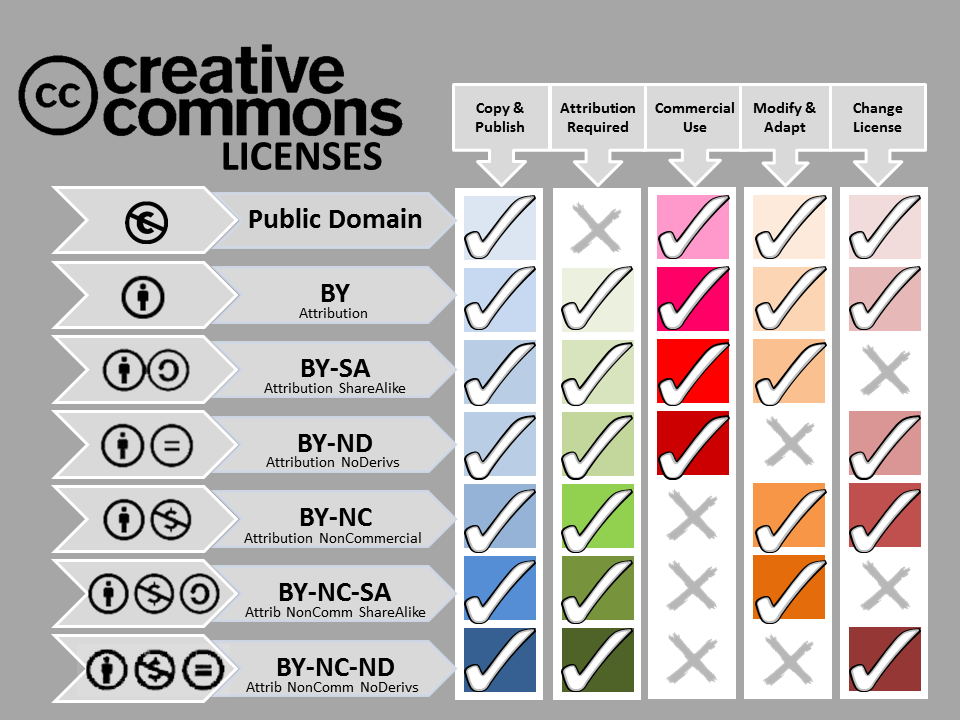
Figure 1:Creative Commons License Types. From George Washington University Libraries Open Textbooks. Used under a CC-BY 4.0 licence.
The six licenses and the public domain dedication tool give creators a range of options. The best way to decide which is appropriate for you is to think about why you want to share your work and how you hope others will use that work.
The Creative Commons License Chooser is a good place to assess which type of license is a good fit for your work.
Other Licenses for Documentation
GNU Free Documentation License (GFDL): Often used for documentation alongside GNU software, GFDL requires users to use and distribute modified versions under the GFDL. Wikipedia is a prominent use of this license. Visit gnu.org for details.
Fonts: The Open Font License (OFL) attempts to be a compromise between the values of the free software and typeface design communities. It is used for almost all open source font projects, including those by Adobe, Google and Mozilla. Visit choosealicense.com for details.