A license is a legal agreement between the creator or owner of a resource (such as software, data, and documentation) and its users. The specific license accompanying a resource clearly defines the scope and communicates what users can and cannot do with the work. This protects the creator’s rights over their resources while granting users some limited rights.
This chapter was written using American English, in which the word license is a noun and a verb. With British English, however, licence is a noun (as in, the software is released under a permissive open source license), while license is a verb (as in, they licensed the event).
Prerequisites
No previous knowledge is needed; this chapter explains how important it is to understand how laws and licensing can affect your project.
Summary
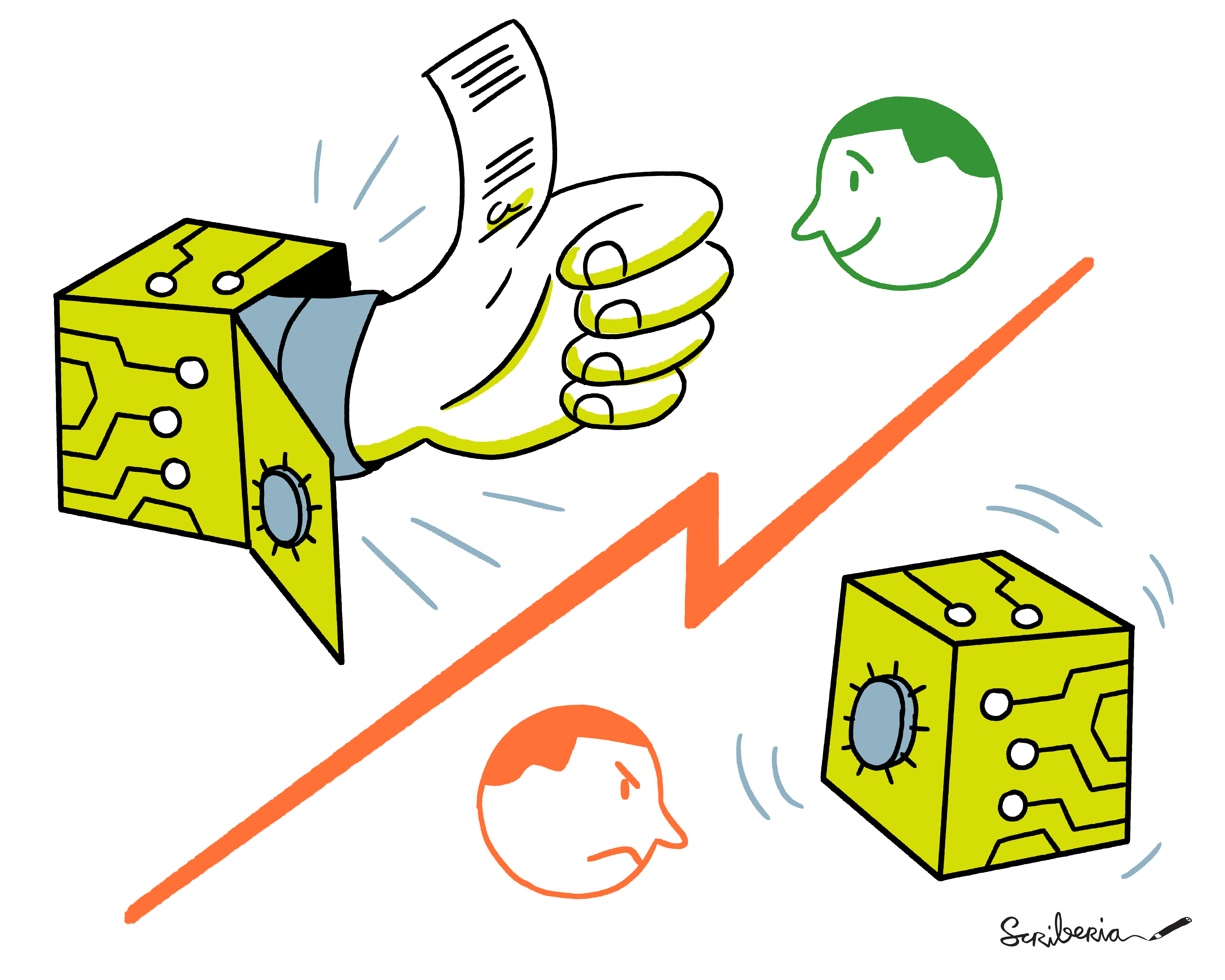
Figure 1:Licensing. The Turing Way project illustration by Scriberia. Used under a CC-BY 4.0 licence. DOI: The Turing Way Community & Scriberia (2024).
Licensing of software, data, AI/ML models, hardware and other creative works, such as documentation and visuals, shares common attributes and concepts. This chapter describes those concepts, making it easier for more people to read and understand the rights granted by most licenses relevant to the research and data science community.
What, How and Where of License Documentation
Licenses are legal documents that the licensor attaches to the artefacts they share with the licensee/their users. A license should be clearly visible and state the chosen conditions of the agreement.
A project with multiple resources is organised in a hierarchy of directories and files.
A licensor should place a plain text file containing the license agreement in the top-level (root) directory of their project.
In a git project, for example, that is shared on a git forge like GitHub or GitLab, a standard file with a name like LICENSE will allow the license to be picked up by the host and displayed on their online project repository.
If the license has a standardised short name from SPDX, then this will be displayed as a small icon on the project’s home page by these hosts.
It can also be useful to include license information in the form of standard strings at the top of each text file in the project.
There are useful tools which automate this available from REUSE, a project from the FSFe which developed the spec. This is especially true if your project contains material that is licensed in multiple different ways, or a part of your project is being used in someone else’s which uses a different (compatible) license.
Explore Different Subchapters
In the following subchapters, you will learn about licensing principles, recommendations and guidance for selecting appropriate licenses for different artefacts:
- Intellectual Property. (2025). https://datamanagement.hms.harvard.edu/share-publish/intellectual-property
- The Turing Way Community, & Scriberia. (2024). Illustrations from The Turing Way: Shared under CC-BY 4.0 for reuse. Zenodo. 10.5281/ZENODO.3332807