Governance is a set of formal and informal practices through which an organisation sets goals, assigns responsibilities, establishes systems, and assesses outcomes of organisational action.
The governance body of The Turing Way is represented by the members of the Steering Committee, Working Groups and volunteer members from the community involved in defining and leading different initiatives (both funded and informally organised) within The Turing Way.
Like the book itself, the governance of The Turing Way is always a work in progress! We are very keen to discuss and improve our governance approaches with the involvement of our community members.
Three Levels of Decision Making
In 2023-2024, The Turing Way adopted three institutional “levels”. Originally described in the context of Studies of the institutional design of natural resource commons Ostrom (2005) and later adopted in the free and open source software (FOSS) communities to describe three broad levels of formal and informal norms that affect decision-making Charles M Schweik & English (2007).
The “Community level" norms influence the everyday decisions and actions made by community members such as participating in the community and contributing to the book.
The “Maintenance” level describes different groups of people coming together to work on and promote specific areas and initiatives in the project as well as defining or changing processes to make community level participation easier.
At the “Constitution” level, nominated community leaders from the Maintenance level participate in the Turing Way Steering Committee. The Steering Committee covers decisions at a strategic, whole-project level, such as the establishment of Working Groups, and creating and revising project-related norms that affect the whole of the project, the community and their sustainability.
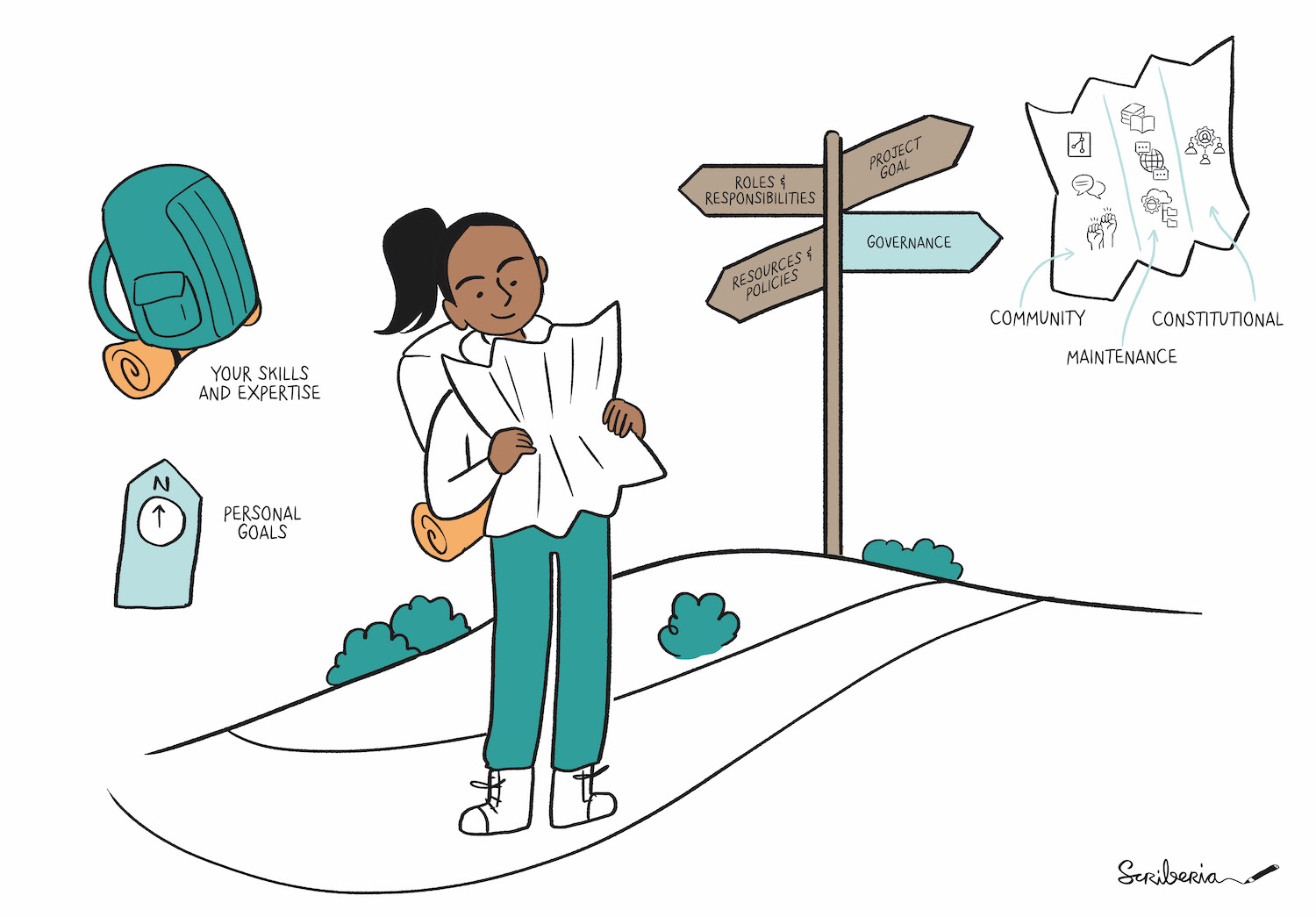
Figure 1:The Turing Way’s governance occurs across community, maintenance and constitution levels. The Turing Way project illustration by Scriberia. Used under a CC-BY 4.0 licence. DOI: The Turing Way Community & Scriberia (2024).
Each level of decision-making should inform and influence each other, both applying and evolving governance processes in order to build transparent and accountable governance of The Turing Way.
Below, we describe these three levels of decision-making in the context of The Turing Way, inputs for which were invited from open discussions with our community members (follow Miro board for details). This model was presented at a Community Forum in February 2024, a recording of which is shared below.
This is a recording from the first public Community Forum hosted in February 2024.
However in-depth one would like to engage in The Turing Way, we create opportunities for community participation, skill building and pathways to leadership in data science. We discuss these roles and opportunities so that you can identify the best level of engagement for yourself in the project and our community.
We want to ensure that all roles are recognised and valued in The Turing Way.
Therefore, from the onset, we have worked to define these different paths for engagement, support and acknowledgement for community members in The Turing Way.
You can read the details in our community handbook in the [acknowledging contributors] chapter (https://
1. Community Level
This level encompasses all members of The Turing Way community, both longstanding and new. Members may have made contributions to the book, participated in an event or simply engaged as book users, social media followers, Slack Workspace members or independent advocates of The Turing Way.
Decisions and activities undertaken by community level members may include the following:
Making individual contributions such as creating an issue, fixing a bug, committing a change on existing chapters, and reviewing Pull Requests.
Joining and inviting new individuals to community meetings such as Collaborations Cafe and Co-working sessions.
Presenting about The Turing Way at an event.
Initiating a conversation or posing a question in The Turing Way community channels.
Suggesting content for The Turing Way Newsletter.
Applying to participate in the bi-annual Turing Way Book Dashes.
Proposing an idea for training sessions or community events.
Proposing a new initiative such as a Working Group.
Taking any book-related roles in writing, reviewing or maintaining a chapter.
Translating any part of The Turing Way chapters and resources.
Establishing a collaboration.
Helping others with some issues they raise on GitHub or ask on Slack.
Asking a question or help!
Other things that you can do as individuals.
We have discussed specific roles under this level in Community and Community Roles.
Guidelines and processes for this level are described in the contribution guidelines and Community Handbook. These processes and resources are co-developed by maintenance-level members with the involvement of members from the community and constitution levels as needed.
2. Maintenance Level
This level includes members from different Working Groups of The Turing Way.
The Turing Way also collaborates with various projects and initiatives, whose participants form Project Delivery Groups. While these projects may have distinct goals, funding, host organisation, leadership, and timelines, they fall within The Turing Way’s scope. To ensure accountability and alignment with the overall project and community interests, Delivery Group representatives join The Turing Way’s Steering Committee.
You can find details about these members in Governance Roles.
Responsibilities at the maintenance level
Members at this level share responsibilities for The Turing Way community management and project maintenance. Decision-making at the maintenance level must stay with the community and stewards of the community participating at this level. They are also responsible for making the process of participation at the community level transparent for other community members.
Decisions at the maintenance level
Decisions at the maintainer level may include the following:
Setting up, leading or representing a WG in different types of roles as leads, co-leads, secretaries and contributing members.
Facilitating the creation of a new WG
Decisions for planning and hosting the WG meetings and recurrence of the meetings.
Organising and distributing the responsibilities within each WG.
Proposing which conferences to participate in or apply to represent their work in The Turing Way.
Proposing funding ideas/proposals or responding to a call for applications to support their work in The Turing Way.
Suggesting changes in ongoing processes or current working models through discussions.
Organising a Fireside Chat event in conversation with the Community Management Working Group.
Clarifying unclear processes that guide the work of a WGs.
Escalating issues that can not be addressed at the maintainer level.
3. Constitution Level - Steering Committee
The constitution level is represented by The Turing Way Steering committee, which is comprised of the 1) chairs of Working Groups, and 2) leads of Delivery Groups of projects in The Turing Way, both with defined goals and deliverables. Working Group chairs or Delivery Group leads may also appoint another member from their group or team to represent their work within the committee. The aim is to ensure consistent representation in the Steering Committee by a stable group of individuals who can provide continuity in knowledge and leadership, contributing effectively to the committee’s shared objectives.
Governance at this level encompasses strategic decisions and significant project changes, including project goals, governance processes, funding, recruitment and shared leadership.
Responsibilities of the Steering Committee
Steering Committee members are responsible for escalating project- and community-wide decisions to the constitution level and participating in the decision-making processes. They actively engage community members by transparently sharing decisions and outcomes from the constitution level discussions.
Their responsibility includes ensuring that the community engagement, contribution and decision-making process, which affects the broader project and the community functioning, is developed and kept transparent and where possible, involves the rest of the community. They solicit feedback via GitHub issues and newsletters and approve changes that improve project and community functioning.
Decisions at the constitution level
Decisions at the constitution level may include the following, but are not limited to:
Providing leadership and strategic directions in the project.
Providing advice and ensure accountability for community- and maintenance level efforts.
Building clarity around resources available for the maintainers and community members.
Process whereby the chair/representatives of the WGs can represent community and WG interests at this level of decision-making.
Supporting the application for core funding, staff recruitment and budget allocation.
Ensuring that the project’s directions is informed by the community.
Designing additional community representation roles such as through an Advisory Group.
Supporting other members in developing process documentation for their decision-making process, and identifying resources they need to continue their work.
Supporting project-wide and community-wide concerns and communicating them transparently to the community.
Community Forums
Since 2024, the constitution level group has been hosting open/public community events called ‘Community Forums’ to discuss governance-related matters with our community members and anyone who is interested in understanding the community and project management aspects of The Turing Way. Modelled off a political town hall event, these online sessions are an opportunity to better understand activities across the project and how decisions are made. Our aim is to leverage the expertise across our community, and we explicitly invite you to review our processes and recommend improvements.
Please join Community Forums to stay up to date with the development.
Recordings from all Community Forums have been published on our YouTube channel.
You can find out about our next Community Forums in the monthly newsletters.
Join us in building this community together!
- Ostrom, E. (2005). Understanding Institutional Diversity / E. Ostrom. Princeton, NJ. https://www.researchgate.net/publication/50209015_Understanding_Institutional_Diversity_E_Ostrom
- Charles M Schweik, & English, R. (2007). Tragedy of the FOSS Commons? Investigating the Institutional Designs of Free/Libre and Open Source Software Projects. Charles M Schweik, 12(2). 10.5210/fm.v12i2.1619
- The Turing Way Community, & Scriberia. (2024). Illustrations from The Turing Way: Shared under CC-BY 4.0 for reuse. Zenodo. 10.5281/ZENODO.3332807